


What do we mean when we talk about digital outdoor advertising? Digital out of home (DOOH) includes two main forms of advertising: digital place-based networks and digital signage. It encompasses everything from electronic billboards to digital boards on the side of buses to kiosks at the mall.
Digital out of home ads all have two things in common. They appear on digital screens, and their creative can be swapped out remotely from a server. This makes it very easy to move different advertisers in and out of the space — something traditional out of home cannot do.
Digital out of home ads accounted for 34% of all U.S. out of home ad spend in 2024, according to the OAAA — and that share is growing every year.
In fact, 55% of all OOH revenue growth between 2024 and 2025 came directly from DOOH, cementing its role as the engine driving the entire industry forward.
Are you interested in digital advertising for your products, or do you just want to understand more about this emerging medium? We’ve put together this guide to everything you need to know about digital OOH ads — answering the questions we hear most from clients.
What Is Digital Billboard Advertising?
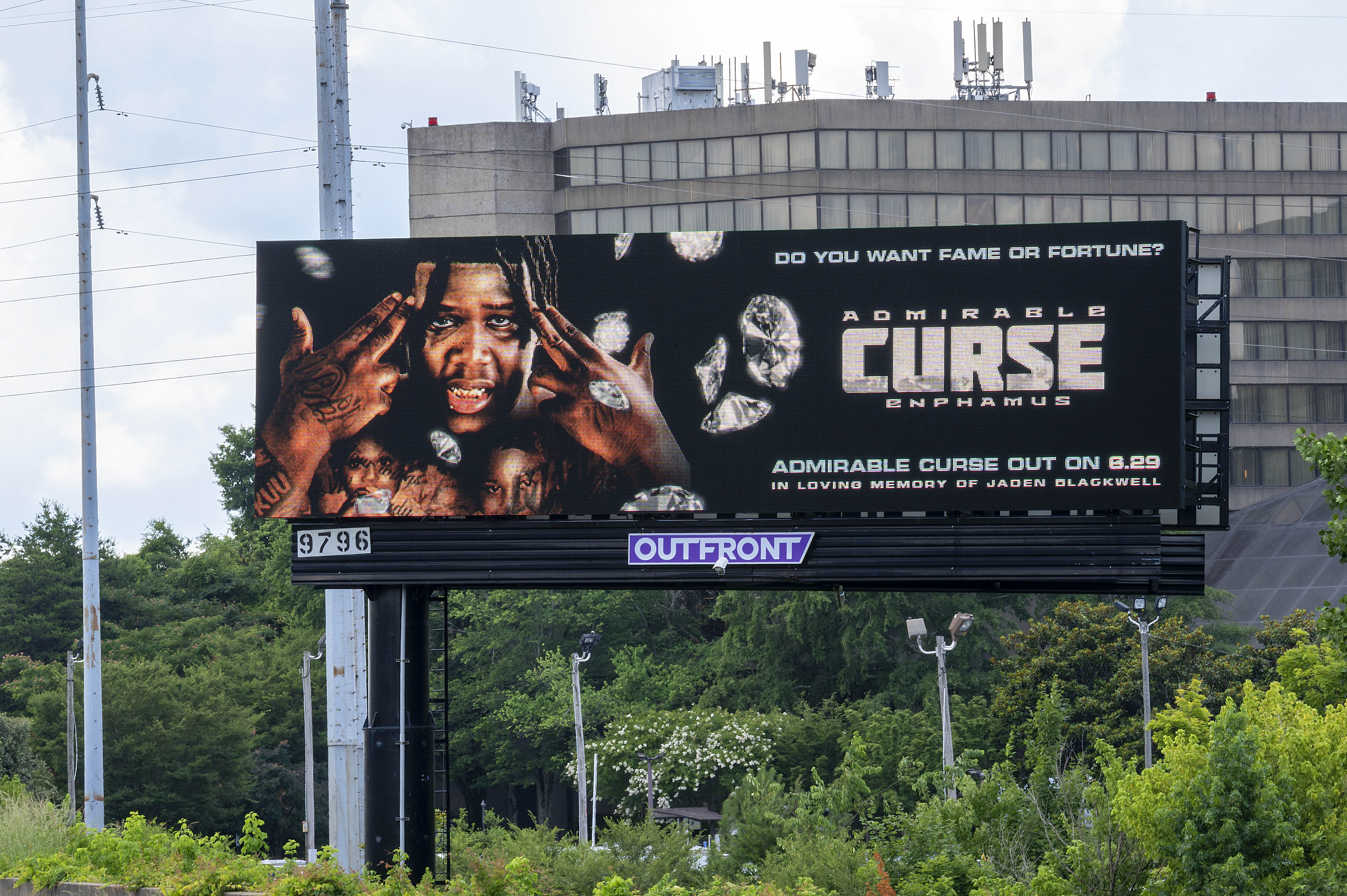
Digital billboards are large-format LED displays — essentially giant screens on the side of the road — that show rotating ads, typically switching creative every 6 to 8 seconds. You’ll find them along major highways, busy city streets, and high-traffic urban corridors across the country.
Unlike traditional static billboards, digital boards are connected to a server, which means your creative can be uploaded and live in minutes rather than weeks. There’s no vinyl to print, no crew to send out, and no waiting.
That speed and flexibility is a big part of what makes digital billboard advertising so appealing to brands that need to move fast — whether that’s a music label promoting an album drop, a brand reacting to a cultural moment, or a retailer pushing a weekend sale.
Digital billboards also rotate among multiple advertisers, displaying each ad in sequence throughout the day. This shared model is one reason digital boards typically cost less than traditional billboards, while still delivering strong reach and visibility in premium locations.
Advantages of DOOH Digital Billboards
Digital billboards offer a set of advantages that traditional static boards simply can’t match. Here’s why brands keep coming back to DOOH:
- Flexibility: Upload your creative to the vendor in minutes and it’s live. No vinyl to print, no installation crew to schedule — compared to traditional billboards that can take a month or longer to go up, digital is almost instant.
- Timeliness: Run a live countdown to a product launch, react to breaking news, display a real-time social media feed, or swap creative based on the weather or time of day. Digital boards let you stay relevant in a way static formats never could.
- AI-powered targeting: Modern digital billboards can now incorporate artificial intelligence to dynamically serve different creative based on real-time signals — foot traffic, demographics, local events, and more. Around 45% of advanced DOOH deployments now switch creative automatically based on these triggers.
- Effectiveness: The ROI on digital boards is strong. More than half of people report seeing a DOOH billboard within the past month, and according to a 2024 survey, 74% of mobile users took action on their phones after seeing a DOOH ad — from searching for a brand online to visiting its website or social media pages.
- Cost efficiency: Because digital boards rotate among multiple advertisers, you’re sharing the cost of a premium location rather than bearing it alone. That makes DOOH accessible at budgets that wouldn’t support a traditional billboard buy.
- Measurability: Unlike static OOH, digital campaigns can be tracked, optimized, and reported on in near real time — making it far easier to demonstrate performance to clients and stakeholders.
Are Digital Billboards Safe?
Yes. The safety of digital billboards has been debated for years, and some municipalities even moved to ban them early on out of concern that rotating, illuminated displays would distract drivers. But the research has settled the question.
Multiple independent studies have found that digital billboards are safe and show no meaningful correlation with increased traffic accidents.
Drivers don’t fixate on digital boards any longer than they do on traditional static ones — and in many cases, the brief, high-contrast nature of digital creative means less visual searching than a cluttered static poster.
The Federal Highway Administration has studied the issue extensively. The overwhelming consensus among traffic safety researchers is that digital billboards, when properly regulated for brightness and dwell time, pose no greater risk than any other roadside signage.
How Much Does It Cost to Buy a Digital Billboard?
Digital billboard pricing isn’t one-size-fits-all. A number of variables determine what you’ll pay, and the range can be dramatic — from a few hundred dollars a week in a smaller market to tens of thousands in a prime urban location. Here’s what drives the cost:
- Market: Where you buy matters more than almost anything else. A digital billboard in Times Square or on the Sunset Strip will cost exponentially more than one in San Antonio or Albuquerque. Major metros command premium rates because of the sheer volume of eyes on the board.
- Location within the city: Even within the same market, location makes a big difference. In Los Angeles, for example, a board on Sunset Boulevard will cost significantly more than one on the 405 in Torrance — even if they’re the same size and run for the same duration.
- Length of the buy: Digital billboards can be purchased for as little as a single day, making them far more flexible than traditional boards that typically require a four-week minimum. Shorter buys cost less overall but often carry a higher effective rate per day.
- Size: Digital boards come in a range of sizes, from smaller street-level displays to massive highway bulletins. Larger formats cost more, both because they reach more people and because the production and maintenance costs are higher.
- Technology: Newer boards with higher resolution, greater brightness, and advanced programmatic capabilities command higher rates. An older display in a secondary location will always be cheaper than a cutting-edge LED screen in a high-traffic corridor.
- Share of voice: Digital boards rotate among multiple advertisers. The more frequently you want your ad to appear — your share of the rotation — the more you’ll pay. The industry standard is typically 10 to 20 percent share of voice.
For a deeper look at what to budget, check out our complete guide to billboard advertising costs.
What Is the General Price Range of Digital Billboard Advertising?
Keeping in mind the many variables in billboard pricing, here’s a rough breakdown of what you can expect to pay:
- Small and mid-size markets: $300–$800 per week
- Large markets (Chicago, Houston, Miami): $1,000–$3,000 per week
- Major metros (Los Angeles, New York): $3,000–$10,000+ per week depending on location and share of voice
- Premium locations (Times Square, Sunset Strip): Can run significantly higher, often into five figures per week
These are rough averages — your actual rate will depend on market, size, duration, share of voice, and the vendor.
As a general rule, digital billboards tend to cost less than traditional billboards in the same location, because you’re sharing the board with other advertisers rather than owning 100% of the space for the full flight.
That shared model is actually one of the things that makes DOOH so accessible — brands that couldn’t justify a traditional four-week buy can still get meaningful exposure on a premium digital board at a fraction of the cost.
How Much Does Digital Cost Compared to Traditional Billboards?
Digital billboards typically cost less than traditional billboards in the same location. There are two structural reasons for this:
- Shared space: On a digital board, your ad rotates alongside other advertisers — usually on an 8-second loop shared among 4 to 6 brands. That means you’re buying a share of voice rather than exclusive ownership of the display. Traditional billboards give you 100% of the space for the entire flight, which is why they command a higher price.
- Shorter minimum buys: Traditional billboards are typically sold in four-week increments, which means a larger upfront commitment. Digital boards can be purchased by the day, week, or even by daypart — lowering the barrier to entry and making it easier to test a market before committing to a longer run.
That said, digital isn’t always cheaper on a pure CPM basis. In high-demand markets, a premium digital location with strong foot traffic and a well-positioned screen can approach or exceed the cost of a nearby traditional board.
This is especially true if you’re buying a higher share of voice or running across multiple dayparts.
The bottom line: for most markets and most budgets, digital delivers more flexibility and lower cost of entry than traditional. But the best buy depends on your goals, your market, and how much share of voice you actually need to make an impact.
How Many Outdoor Digital Billboards Are There?
The U.S. digital billboard inventory has grown dramatically over the past decade. There are now more than 16,000 digital billboards across the United States — up from roughly 8,100 just a few years ago, representing growth of over 40% in recent years alone.
That number continues to climb as vendors upgrade static inventory to digital and new locations come online.
To put it in perspective: digital boards still represent a small fraction of the more than 350,000 total billboards in the country. That scarcity is actually part of what makes them valuable — digital locations tend to be in high-traffic, premium positions, which is why demand remains strong even as supply grows.
The pace of digitization is only accelerating. Digital billboards are projected to grow at a 6% compound annual growth rate going forward, driven by programmatic buying, AI-powered targeting, and brands increasingly shifting budgets from traditional media into DOOH.
What Are Digital Billboards Made Of?
The structure of a digital billboard isn’t all that different from a traditional one. The base and support column are typically made from galvanized steel, engineered to withstand high winds, weather exposure, and the added weight of the electronic display components.
What sets digital boards apart is what sits on top: a large-format LED panel array. These panels are made up of thousands of individual light-emitting diodes arranged in a grid, which together produce the high-brightness, high-contrast images you see from the road.
Modern LED displays are designed to remain clearly visible in direct sunlight. Most highway digital billboards operate at 5,000 to 7,000 nits or higher — a brightness rating that ensures visibility in any lighting condition.
The LED panels connect to an onboard computer and content management system maintained by the vendor. When an advertiser uploads new creative, it’s pushed to the board via a cellular or internet connection and goes live almost instantly — no physical installation required.
Compared to the vinyl skins used on traditional billboards, LED panels require more upfront investment but have a much longer operational lifespan. There’s nothing to print, ship, or install for each new ad, which means far lower ongoing production costs.
How Do Electronic Billboards Work?
The process behind a digital billboard campaign is simpler and faster than most people expect. Here’s how it works from start to finish:
- Creative development: The agency works with the client to develop the ad concept and produces the final creative in a digital format — typically a static image or short animation sized to the specific board’s pixel dimensions.
- File submission: The finished creative is submitted to the vendor, usually through an online portal or via email. Most vendors have straightforward spec requirements covering file format, resolution, and file size.
- Upload and scheduling: The vendor uploads the creative to their content management system and schedules it to run according to the campaign parameters — specific dates, dayparts, and share of voice.
- Live display: The billboard pulls the creative from the server via a cellular or internet connection and begins displaying it almost instantaneously. Changes or updates can be made just as quickly, which is one of the biggest advantages digital has over traditional.
Compare that to a traditional billboard, which requires the creative to be printed on large-format vinyl, shipped to the location, and physically installed by a crew. That process can take several weeks and adds meaningful cost to every campaign.
With digital, there’s no print production, no shipping, and no installation. The only physical asset is the screen itself, which the vendor owns and maintains.
This streamlined workflow is one of the reasons brands can turn around a digital billboard campaign in days rather than weeks — and why DOOH is increasingly the go-to format for time-sensitive campaigns.
What Types of DOOH Are There?
Digital out of home is a much broader category than most people realize. While large-format digital billboards along highways and city streets are the most visible format, DOOH encompasses a wide range of screen environments — each with its own audience, dwell time, and advertising context. The main categories include:
- Digital billboards: Large-format LED displays on highways, arterials, and urban corridors. High reach, high visibility, and ideal for broad brand awareness campaigns.
- Street furniture: Digital panels embedded in bus shelters, kiosks, benches, and phone booths. Located at street level where pedestrian traffic is highest, making them effective for local and hyper-targeted buys.
- Transit: Digital screens inside subway cars, on the sides of buses, inside train stations, and at airports. Captive audiences with longer dwell times make transit DOOH particularly strong for detailed messaging.
- Retail and point-of-sale: Screens inside shopping malls, grocery stores, convenience stores, and gas stations. These placements put your brand in front of consumers at or near the moment of purchase — a powerful position for CPG and retail advertisers.
- Place-based networks: Digital screens in doctors’ offices, gyms, bars, restaurants, hotels, and college campuses. These environments allow for highly contextual targeting based on the audience that frequents each type of venue.
- Spectaculars: Large-scale custom digital installations in landmark locations — Times Square being the most famous example. Used primarily for high-impact brand moments and cultural activations.
Each format reaches a different audience in a different mindset. That’s why many effective DOOH campaigns layer multiple environments together rather than relying on a single placement type.
A campaign might combine highway billboards for reach with place-based screens for contextual relevance and transit for frequency.
How Do You Buy Electronic Billboards and How Is It Different From Traditional?
The fundamentals of buying a digital billboard aren’t dramatically different from buying a traditional one — but there are some key differences in flexibility, pricing structure, and how campaigns are increasingly being transacted.
The Traditional Buying Process
In a direct buy, an agency identifies target locations, negotiates pricing and flight dates with the vendor, and secures the placement.
The major vendors that dominate traditional billboard inventory — Clear Channel Outdoor, Lamar, and Outfront Media — also control the lion’s share of digital billboard inventory, so the vendor relationships are largely the same.
Share of Voice
Unlike traditional billboards where you own 100% of the display for the entire flight, digital buys are priced on share of voice — how frequently your ad appears in the rotation cycle.
The industry standard is typically 10 to 20 percent share, meaning your ad shows roughly once every 5 to 10 spots. Higher share of voice means more impressions but a higher cost. Some buys go up to 30 percent or more depending on budget and campaign goals.
Programmatic Buying
One of the biggest differences from traditional is the rise of programmatic DOOH. Rather than negotiating directly with a vendor, programmatic allows buyers to purchase digital billboard inventory through a demand-side platform (DSP).
Buyers can target audiences by location, time of day, demographics, and even real-time triggers like weather or live events. Programmatic DOOH spending in the U.S. grew 34% in 2024 and is projected to surpass $1.22 billion by 2026 — making it one of the fastest-growing segments in all of advertising.
Minimum Commitments
Traditional billboards typically require a four-week minimum. Digital boards are far more flexible — you can buy by the day, week, or daypart.
That flexibility lowers the barrier to entry and makes it easier to test a market or react quickly to a cultural moment.
What Are the Biggest Digital Out of Home Advertising Trends?
DOOH is evolving faster than almost any other advertising format right now. Here are the trends reshaping the industry in 2025 and beyond:
- Programmatic buying at scale: Big data has moved from buzzword to standard practice in DOOH. Buyers are now using audience data, location intelligence, and real-time signals to plan, execute, and optimize campaigns the same way they would a digital media buy. Programmatic DOOH grew 34% in the U.S. in 2024 alone, and more than 70% of DOOH spend in North America is now transacted programmatically.
- AI-powered dynamic creative: Artificial intelligence is enabling billboards to serve different creative automatically based on real-time triggers — weather conditions, time of day, local events, foot traffic, and even audience demographics detected by on-site sensors. Around 45% of advanced DOOH deployments now use AI-driven dynamic content switching.
- Cross-channel integration: DOOH is increasingly being planned and measured alongside digital channels rather than in isolation. Brands are pairing billboard exposures with mobile retargeting, social media, and CTV to create sequential messaging that follows consumers across screens and environments. A 2024 survey found that 74% of mobile users took action on their phones after seeing a DOOH ad.
- Retail and proximity targeting: The deployment of beacons, geofencing, and proximity data is allowing advertisers to connect DOOH exposures directly to in-store visits and purchase behavior — closing the attribution gap that has historically made OOH harder to measure than digital channels.
- Experiential and immersive formats: Augmented reality, 3D anamorphic displays, and interactive installations are pushing the creative boundaries of what a billboard can do. These formats generate outsized earned media and social sharing, amplifying the reach of a physical placement well beyond its immediate audience.
- Sustainability: As LED technology improves and vendors invest in solar-powered displays and smarter energy management, sustainability is becoming a real differentiator — and an increasingly important factor for brands with ESG commitments.
The common thread across all of these trends is measurement and accountability.
DOOH is shedding its reputation as an untrackable brand-awareness play and becoming a data-driven, performance-oriented channel that can hold its own in any media mix.
Still have questions about digital out of home advertising? Whether you’re planning your first DOOH campaign or looking to scale an existing one, our team knows this medium inside and out.
Get in touch with Dash Two and we’ll get you the answers you need.