
It beats banner blindness.
The average person sees somewhere north of 5,000 ads a day and remembers almost none of them. An experience interrupts that pattern because it's not asking to be ignored — it's asking to be participated in.
Outdoor Advertising
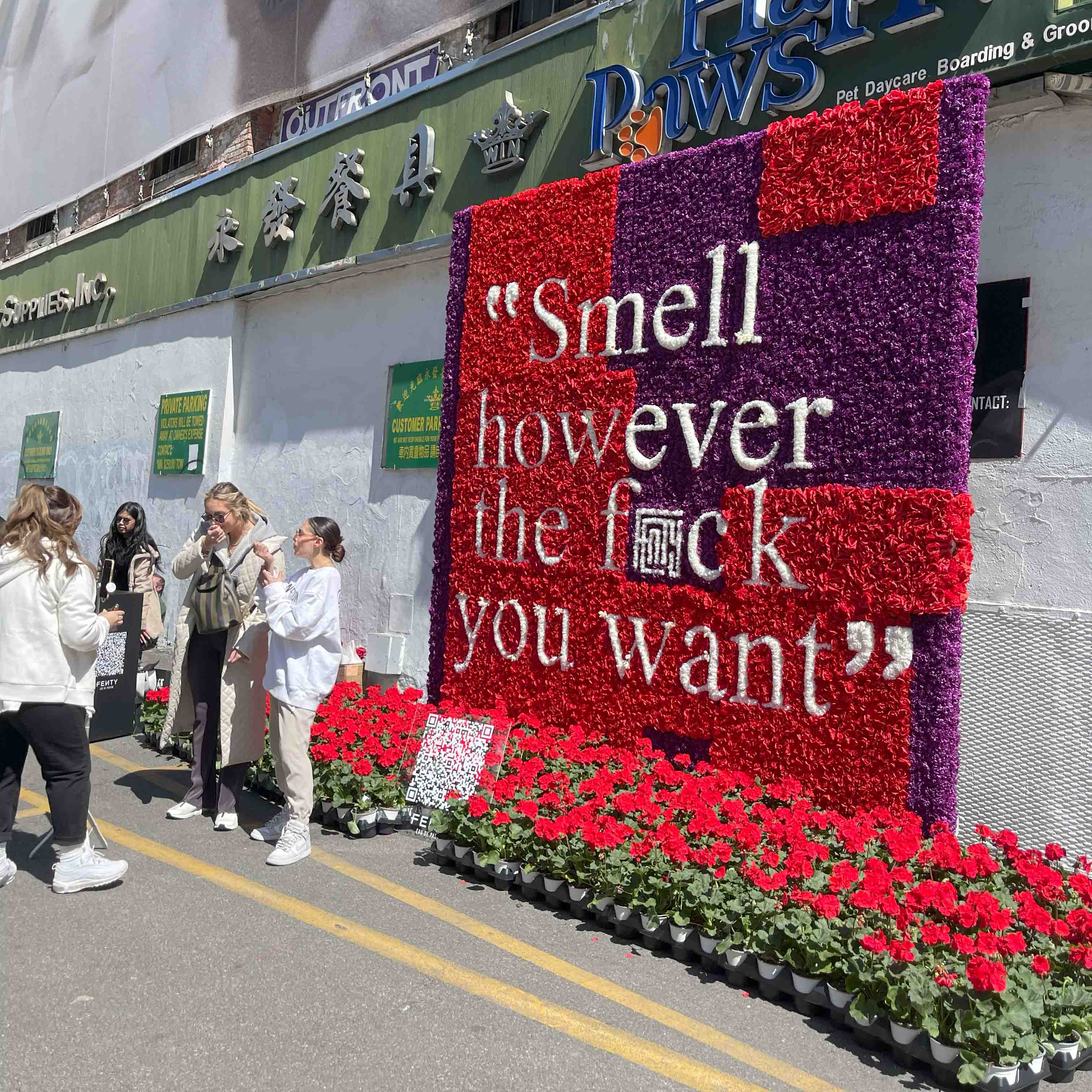
You’re walking down the street and you spot a sign over a bed of flowers: “Smell however the f*ck you want.” You stop. You smell the flowers. You take a photo. You post it.
We work with companies like…




Experiential marketing — sometimes called engagement marketing, brand activation, or event marketing — is advertising that audiences live through instead of look at. Instead of telling someone what your brand stands for, you build a moment that lets them feel it firsthand.

The format menu keeps getting wider. A few of the most effective types we run for our clients:
Your imagination is the only ceiling. The best campaigns we’ve run started as ideas that sounded a little crazy in the pitch meeting
These are real campaigns we’ve helped bring to life — and a few of our favorite examples of the format firing on all cylinders.
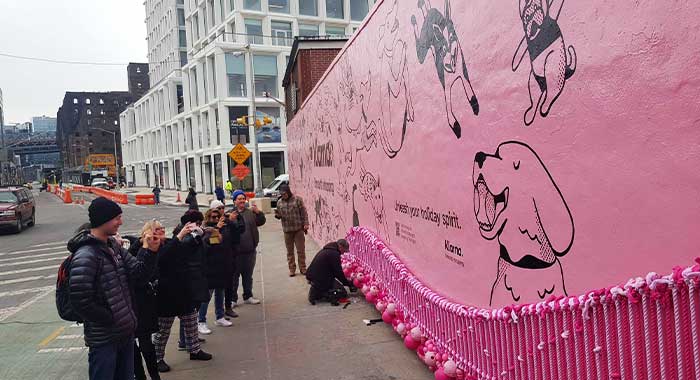
To reach millennial dog owners, we went where they actually spend their weekends — a Brooklyn dog park. We built an interactive mural covered in hundreds of playful, real dog toys. The dogs came for the toys. The owners came for the dogs. The phones came out for the photos. The tagged posts came for days.
01
02
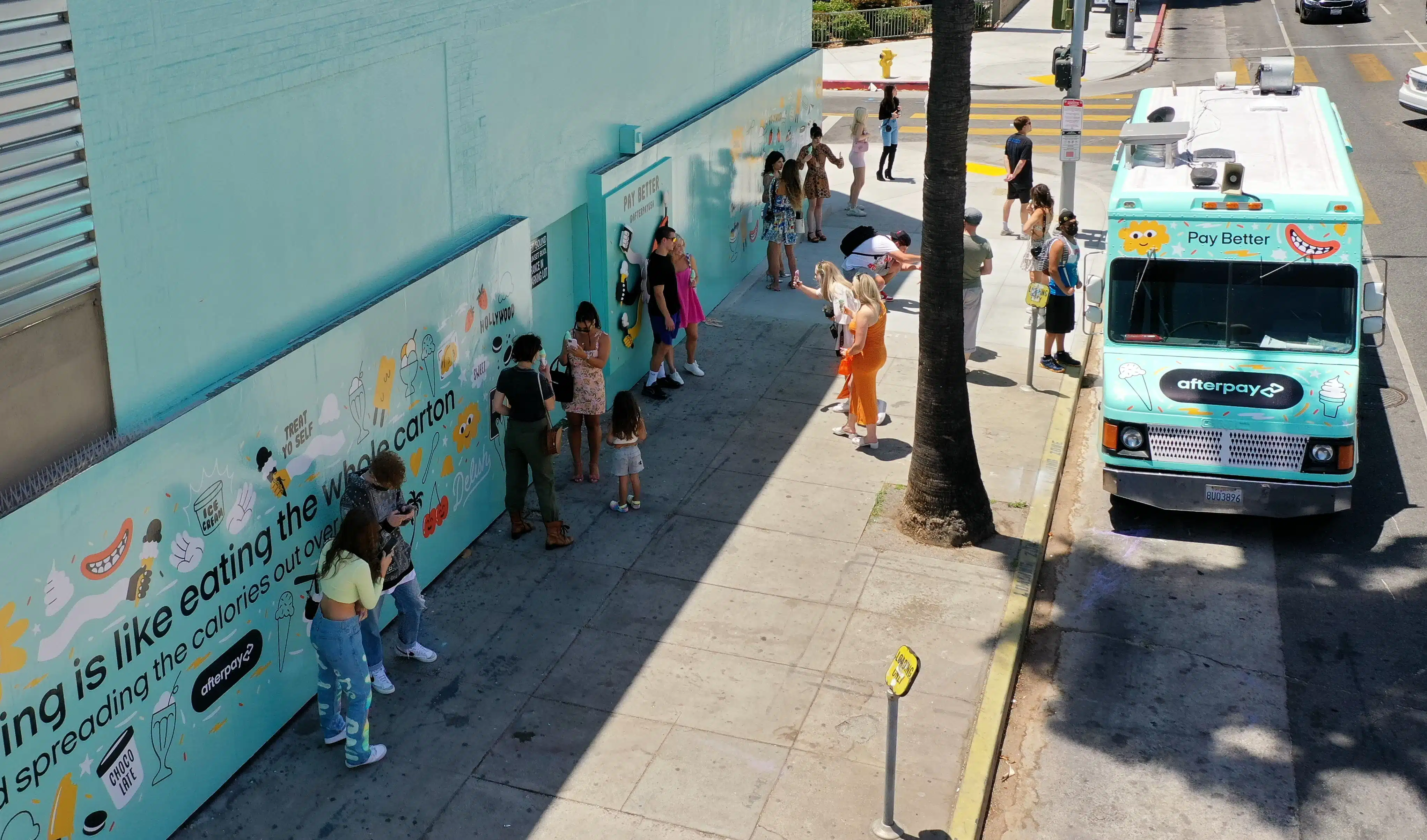
Financial products are notoriously hard to make exciting. So we didn’t try. Afterpay handed out free ice cream from a branded truck with one perfect line on the side: “like eating the whole carton and spreading the calories out over 6 weeks.” The slogan did the explaining. The ice cream did the converting. The crowd did the rest.
03
80,000 flowers. One unforgettable invitation.
To launch Fenty Eau de Parfum, we built a billboard out of 80,000 real flowers — every variety hand-picked to represent a note in Rihanna’s unisex fragrance. The wall toured the country with one perfect line: “smell however the f*ck you want.” The result was the kind of organic social saturation that paid media can’t manufacture — every passerby became a publisher.
04
The average person sees somewhere north of 5,000 ads a day and remembers almost none of them. An experience interrupts that pattern because it's not asking to be ignored — it's asking to be participated in.
Industry data on branded events suggests roughly 85% of attendees walk away more likely to buy. That's a number digital ads almost never touch.
Marketing campaigns that create real emotional connection have been shown to grow new accounts by around 40% and produce customers worth ~52% more in lifetime value than the average buyer. Experiences are one of the most reliable ways to manufacture that connection at scale.
Every phone in the crowd is a distribution channel. A great activation gives people something to film, post, and brag about — and that organic reach is worth multiples of what you paid for the activation itself.
You learn more from ten conversations at a pop-up than from a thousand survey responses. Experiences put you in the same room as the customer, in real time, with their guard down.
Retaining an existing customer costs roughly 5x less than landing a new one. A great experience turns a one-time buyer into a regular — and turns a regular into someone who recruits their friends.
8-SHEET ADVERTISING — NEW YORK

The old knock on experiential was that you couldn’t tie it back to revenue. That excuse doesn’t fly anymore. Here’s what we benchmark on every campaign:
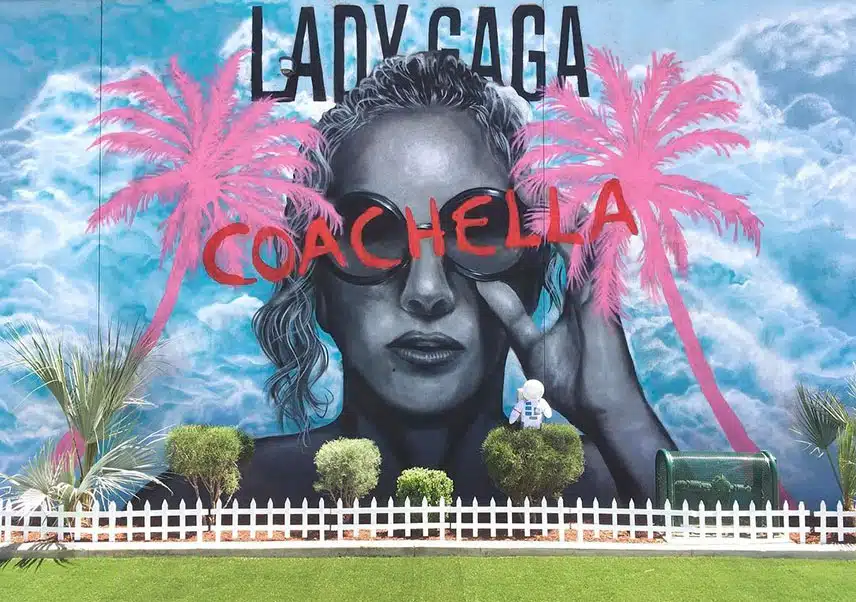
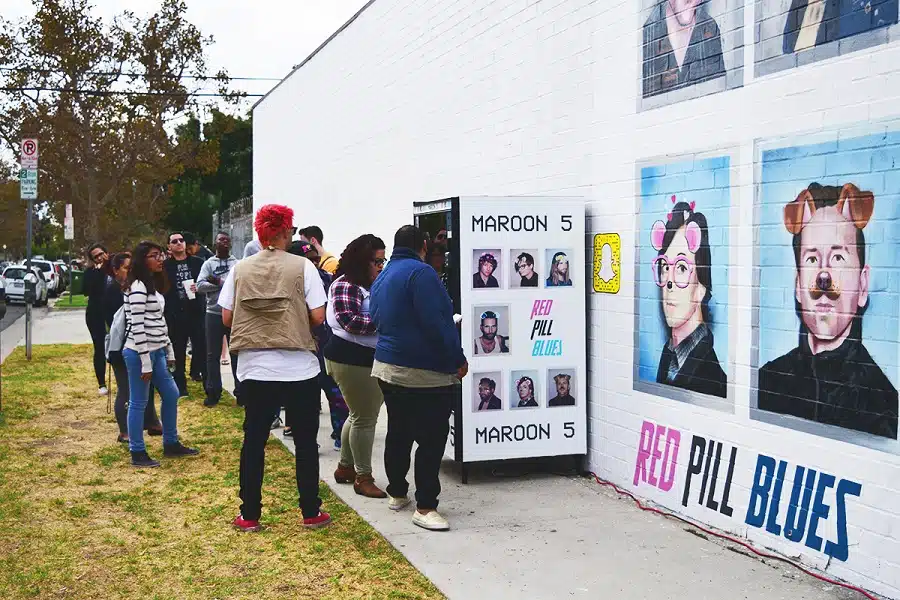
8-SHEET ADVERTISING — LOS ANGELES
Event marketing is one type of experiential marketing. Experiential is the broader category and includes pop-ups, mobile tours, street teams, AR activations, branded installations, sampling programs, and more — anything where the audience participates rather than just observes.
Budgets range widely depending on scope, footprint, and duration. A single-city pop-up can run in the low five figures; a national mobile tour with custom builds, permits, staffing, and media support can run into seven. We’ll scope to your budget, not the other way around.
Simple street team and sampling activations can be ready in 3–4 weeks. Custom builds, permitted installations, and multi-market tours typically need 8–12 weeks of lead time to do right.
Yes — and it’s underused there. Trade-show takeovers, executive dinners, hosted experiences at industry events, and targeted activations near client offices all work. The tactics shift, the principle doesn’t.
Both. We produce the activation and buy the surrounding outdoor, digital, and social media to amplify it. One team, one timeline.
(310) 439-2356 · 214 S. Locust St. #200, Inglewood CA 90301