




1. Frequency
You need to decide how many times your target customer will see your digital ad. This is your effective frequency. Too many impressions and your ad becomes an annoyance — customers experience fatigue when the same ad follows them around the internet on a seemingly endless loop.
The opposite is equally problematic. Showing an ad just once rarely generates the engagement you’re looking for. The goal is finding the balance between overwhelming your audience and being invisible to them.
The easiest way to manage this is with a frequency capper — a setting that limits the number of impressions per user. Before launching your campaign, decide the number of impressions that will yield the best results before performance starts to decline.
To avoid frequency fatigue, consider rotating multiple ads that each offer a different appeal. Changing the design or copy gives your audience a fresh experience even if they’re seeing the same campaign.
Executing successful digital advertising campaigns requires juggling a lot of moving parts — ad type, creative content, audience targeting, marketing channel, landing page composition, and more. It’s easy to get lost in the details.
But there are five key metrics that must not be neglected if you want to see strong conversion rates.
The top 5 digital advertising metrics to watch:
- Frequency / Reach
- CPC: Cost-Per-Click
- CTR: Click Through Rate
- CPM: Cost-Per-Mille (Thousand)
- Relevance / Quality Score
These are the core performance markers of any digital advertising campaign. Let’s break them down.
2. Cost-Per-Click (CPC)
CPC means exactly what it sounds like — every time someone clicks your ad, you pay. Ad platforms ask you to set a target CPC for your campaign, which raises the question: how much should you spend?
There’s no single answer. Your ideal CPC depends on the platform, ad type, target audience, and bidding strategy. As a general rule, you want a revenue-to-ad-spend ratio of around 5:1 — spend one dollar, make five.
A standard way to calculate your target CPC:
(Revenue per sale × website conversion rate) × 20%
For B2B campaigns, the formula accounts for the longer sales cycle:
(Revenue per sale × lead generation rate × internal close rate) × 20%
With a bigger budget you can bid more aggressively and secure higher placement in the ad auction — but only if your CPC math supports it.
3. CTR: Click Through Rate
CTR measures the number of clicks your ad receives relative to the number of impressions. A high CTR is what you’re aiming for — it directly impacts how much you pay per click on a PPC campaign and also feeds into your quality score.
For Google Ads, average CTRs are around 1.91% for search and 0.35% for display. A strong CTR is around 4-5% for search and 0.5-1% for display.
But chasing a high CTR for the wrong reasons can hurt you. A misleading keyword might generate clicks but won’t generate leads — and you’re paying for every one of those clicks. Relevancy is everything.
A few CTR best practices:
- Use keywords that accurately match your offer
- Avoid high-cost keywords that attract irrelevant traffic
- Set up negative keywords to filter out irrelevant searches
- Match your ad copy closely to your landing page content
Targeting relevant, cost-efficient keywords will always lead to better ROI than chasing volume alone.
4. CPM: Cost-Per-Mille (Thousand)
CPM refers to the cost per 1,000 impressions. Unlike CPC, you’re not paying based on performance — it’s an inventory-based model, which is why publishers prefer it. CPM inventory is typically sold before CPC options are even considered.
If you see a $2 CPM, that means you’ll pay two dollars for every 1,000 times your ad is displayed. $2 CPM is a fairly standard benchmark.
CPM is best suited for brand awareness campaigns where you’re focused on getting your message seen rather than driving a specific action. Click-through rate matters less here — reach and impressions are the primary goal.
It’s worth noting that CPM works best when you have high traffic volume to support it. If your audience is too narrow, the cost per meaningful impression can climb quickly.
5. Quality Score
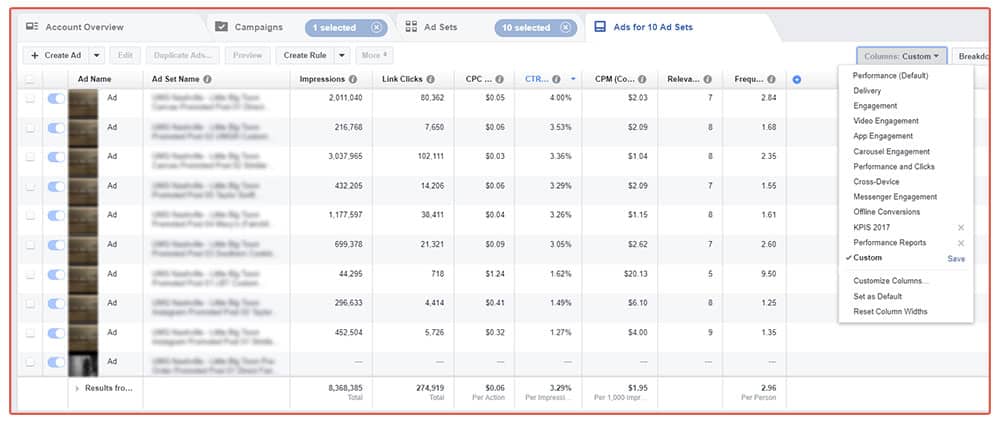
Google rewards high-quality, relevant ads with a discounted CPC rate. Quality Score is determined by multiple factors including your CTR, keyword relevance, landing page quality, ad copy relevance, and past account performance. The higher your score, the less you pay — and the better your ROI.
Think of Quality Score as proof that your ad is genuinely matching the needs of your target audience. Google wants to serve relevant results, and it rewards advertisers who do that well.
To boost your Quality Score:
- Research and add new highly relevant keywords regularly
- Include long-tail keywords in your strategy
- Organize keywords into tightly themed ad groups
- Continuously test and refine your ad copy
- Optimize landing pages to directly match your ad groups
- Add negative keywords to eliminate irrelevant searches and wasted spend
Facebook Ad Relevance Score
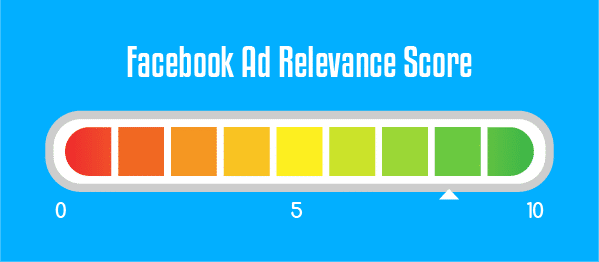
Facebook measures ad relevance on a 1 to 10 scale. Your score becomes visible once your ad has received over 500 impressions — you can find it under your ad-level reporting metrics. Note that relevance scores are not available at the ad set or campaign level.
A high relevance score means your message is resonating with your target audience. Facebook rewards this by showing your ad to more of your ideal audience, which improves frequency efficiency and extends how long you can run the campaign before needing to refresh your creative.
A low relevance score has the opposite effect — Facebook limits your reach, your CTR drops, and you end up paying more per result. Relevance score is determined by social engagement signals including comments, shares, reactions, and CTR.
Elevating Through Relevance
Digital advertising campaigns require constant attention. The best results come from advertisers who regularly tweak, test, and re-evaluate their metrics rather than setting campaigns and walking away.
Neglecting even one of these five metrics can have a significant impact on your results. But when you actively work to improve your click-through rates, frequency, quality score, and relevance together, strong ROI follows.
Need help managing your digital advertising metrics? Get in touch and we’ll help you build campaigns that perform.