
Outdoor Advertising
Aerial Advertising: Airplane Banners, Skywriting, Drones & More
Aerial advertising is any form of marketing that takes place in the sky — from airplane banners and skywriting to drone light shows and floating logos.
We work with companies like…


What We Do
What Is Aerial Advertising?
Brands use aerial advertising at beaches, sporting events, music festivals, and major metro markets to reach large, captive audiences. Whether you’re flying a banner over the Super Bowl or launching a drone show at Coachella, aerial media delivers impressions that are hard to ignore — and even harder to forget.
This guide covers every format, what they cost, where they work best, and how to decide which is right for your campaign.
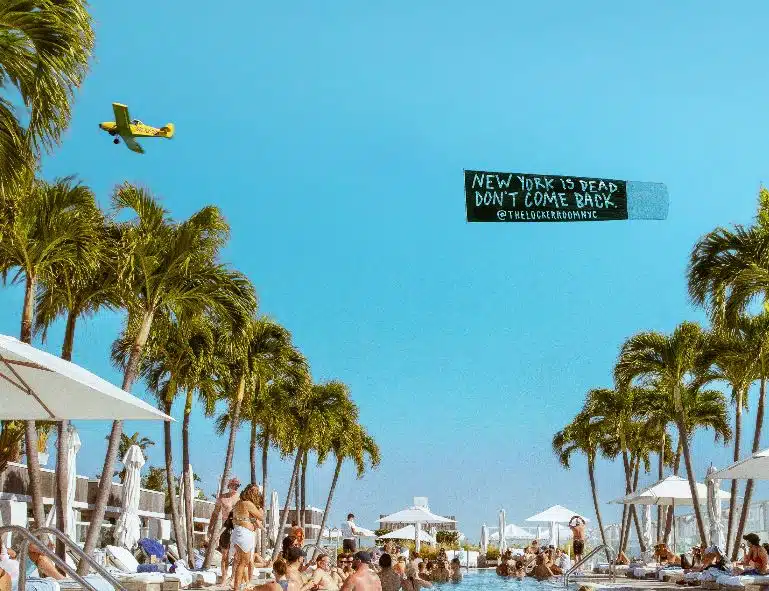
New York is Dead Banner Tow
Types of aerial advertising
Aerial advertising isn’t one format — it’s a category that includes several distinct options, each with its own reach, cost profile, and best-use scenarios.
Airplane Banner Towing
Banner towing is the most established form of aerial advertising. A small aircraft tows a large printed banner over a target area — a beach, stadium, festival, or city corridor. Banners can carry a logo, a short message, or a full billboard-style design. They’re visible to thousands of people at once and can fly repeated passes to maximize exposure.
Pricing typically starts at $1,500 to $15,000+ depending on market, flight duration, and banner size. A single-day campaign in a major market like LA or Miami generally runs $7,000–$9,000, including ferry fees, flight time, and banner production.
For best results, keep copy short and bold — six words or fewer. Add a QR code or vanity URL to bridge the aerial impression with a trackable digital action.
Skywriting and Skytyping
Skywriting uses a specially equipped aircraft to release smoke trails that form letters and shapes in the sky. It’s highly shareable, visually dramatic, and works especially well for short messages, proposals, and event promotions.
Skywriting starts around $4,000–$5,000 for a single message. The main limitation is weather — it requires clear skies, low wind, and moderate humidity. Messages typically last 5–10 minutes before dispersing.
Skytyping is a more reliable alternative: a fleet of aircraft flies in formation, releasing synchronized puffs to create dot-matrix-style messages. The result is larger, more legible, and less weather-dependent than traditional skywriting.
Drone Advertising
Drone advertising has evolved from simple banner-carrying UAVs to choreographed light shows with hundreds of synchronized drones forming brand logos, text, and animations in the night sky. These shows are as much spectacle as advertisement — and they dominate social media, generating earned impressions long after the event ends.
Drone shows have been used at the Super Bowl, Coachella, and major product launches. Some setups also allow for low-altitude giveaway drops — coupons, samples, or branded items — adding a street team element to the aerial activation.
Costs vary widely by scale, ranging from $5,000 for small formations to $100,000+ for large-scale synchronized shows.
Flogos
Flogos are floating foam logos — lightweight shapes made from helium-infused biodegradable foam that drift upward from a ground-based machine. They’re a unique option for outdoor festivals, theme parks, and brand activations, creating a dreamlike visual effect that’s immediately Instagram-worthy.
Because they launch from the ground rather than an aircraft, flogos are easier to permit and deploy in urban environments. They work best as a complement to a larger experiential campaign.
LED Aircraft and Blimps
LED-equipped aircraft and advertising blimps offer nighttime visibility and larger display surfaces than traditional banners. LED aircraft are especially effective at evening events, conventions, and outdoor concerts. Blimps provide extended airtime and wide coverage over large venues. These formats run $5,000–$25,000+ and require more lead time for permitting and setup.
How much does aerial advertising cost?
Aerial advertising costs vary by format, market, flight duration, and production complexity. Here’s a breakdown by format:
| Format | Estimated Cost | Best For |
|---|---|---|
| Airplane Banner Towing | $1,500 – $15,000+ | Beaches, festivals, freeway corridors |
| Skywriting | $4,000 – $10,000 | Short messages, proposals, event launches |
| Skytyping | $8,000 – $20,000+ | Larger messages, more reliable than skywriting |
| Drone Show (small) | $5,000 – $25,000 | Brand activations, product launches |
| Drone Show (large) | $50,000 – $100,000+ | Super Bowl, Coachella, major events |
| LED Aircraft | $5,000 – $25,000+ | Nighttime events, conventions |
| Flogos | $3,000 – $8,000 | Festivals, theme parks, brand activations |
Costs typically include production, pilot or operator fees, and ferry charges to the target location. Campaign length, geographic market, and permitting requirements can all affect the final price. Contact DASH TWO for a custom quote based on your market and objectives.

Lady Antebellum Aerial Banner Ad — CMA Campaign


Keith Urban Aerial Banner Ad
Keith Urban Aerial Banner On Runway
Keith Urban Aerial Banner Ad Pick Up
Best places and events for aerial advertising
Aerial advertising performs best in open environments with high foot traffic and minimal competing visual noise. The most effective locations share a few things in common: large captive audiences, open sightlines, and a context where something unexpected in the sky will actually be noticed.
Music Festivals
Festivals like Coachella, Lollapalooza, Austin City Limits, and Burning Man draw massive concentrated audiences who are already primed for new experiences. Drone shows, banner flyovers, and flogo deployments all work well in this environment — and festival crowds are highly social, meaning your activation is likely to be photographed and shared.
Beaches and Coastal Areas
Beaches are the gold standard for airplane banner campaigns. Crowds are large, attention is idle, and the open sky creates perfect visibility. Summer weekends at high-traffic beaches in LA, Miami, and the Jersey Shore routinely deliver tens of thousands of impressions per flight.
Sporting Events
Major sporting events — the Super Bowl, college bowl games, Formula 1 races, and playoff games — offer a rare combination of large crowds, national media attention, and a captive audience that’s already outdoors and looking up. Aerial advertising at these events can earn both direct impressions and earned media coverage.
City Centers and Urban Corridors
High-traffic urban areas in cities like Los Angeles, New York, Miami, Las Vegas, Chicago, and Austin provide consistent audiences for banner towing and aerial campaigns. Freeway corridors, waterfronts, and downtown cores are especially effective flight routes.
Theme Parks and Tourist Areas
Tourists are relaxed, receptive, and often actively looking for things to photograph and share. Theme parks, boardwalks, and major tourist destinations offer long dwell times and high engagement with unusual or entertaining stimuli — exactly what aerial advertising delivers.
What makes a good aerial ad?
The rules for effective aerial creative are different from any other format. Your audience is moving, the medium is temporary, and legibility is everything.
Creative teams often use these larger formats to introduce motion blur effects, high-contrast typography, or cut-out layouts that command attention in fast-moving environments.
Use high contrast. Bold colors against the sky read better than subtle palettes. Dark text on light banners, or illuminated LED boards for evening flights.
Lead with the brand. Your name or logo should be the first thing a viewer processes — not a tagline.
Add a digital bridge. A vanity URL, QR code, or hashtag turns a passive impression into a trackable action. Increasingly common on banners and drone activations.
Match the context. A playful message works at a beach. A bold brand statement works at a sporting event. Tailor tone to the environment.
Wild Posting® — Los Angeles
Wild Posting® — MLB
Wild Posting® — Door Dash
Wild Posting®
Is aerial advertising right for your campaign?
Aerial advertising isn’t the right fit for every campaign — but when the conditions align, it delivers the kind of impact that’s hard to replicate with any other format.
It works well when you have a specific event, location, or moment you want to own; your audience is concentrated outdoors in an open environment; you want to generate social sharing and earned media alongside direct impressions; and your message is short, visual, and built for immediate recognition.
It’s less effective when your target audience is indoors or dispersed across a wide geographic area; you need to communicate a complex message or detailed offer; or your campaign requires precise frequency or sustained reach over time.
For brands running broader outdoor campaigns, aerial advertising works best as a high-impact complement to billboards, wild posting, or experiential activations — not a standalone media buy.
DASH TWO
Aerial Advertising FAQs
How much does aerial advertising cost?
Costs range from around $1,500 for a short regional banner flight to $100,000+ for a large-scale drone light show. Most single-day airplane banner campaigns in major markets run $7,000–$9,000. Skywriting starts around $4,000–$5,000 for a single message.
What's the difference between skywriting and skytyping?
Skywriting uses a single aircraft releasing continuous smoke trails to form letters freehand. Skytyping uses a formation of aircraft releasing synchronized puffs to create dot-matrix-style text — larger, more legible, and less weather-dependent than traditional skywriting.
Where does aerial advertising work best?
Beaches, music festivals, major sporting events, and high-traffic urban corridors deliver the best results. The ideal environment has large outdoor crowds, open sightlines, and minimal competing visual clutter.
Is aerial advertising effective?
Yes — particularly for awareness and memorability. Studies have shown high recall rates for aerial campaigns, especially when paired with digital reinforcement like hashtags or landing pages. The novelty factor drives social sharing, extending reach beyond the direct audience.
How far in advance do I need to book aerial advertising?
Lead times vary by format and market. Banner towing campaigns can sometimes be arranged within a week, but prime dates near major events book up quickly. Drone shows require more lead time — typically 4–8 weeks minimum — for permitting, choreography, and logistics.
Does aerial advertising require permits?
Yes. FAA regulations govern all commercial aerial advertising in the U.S. Your aerial advertising vendor handles permitting, but campaigns near major airports, restricted airspace, or large events require additional coordination and lead time.
Get In Touch
(310) 439-2356 · 214 S. Locust St. #200, Inglewood CA 90301