
Outdoor Advertising
Taxi Advertising
Taxi advertising — moving billboard campaigns on fleets across New York, Los Angeles, Las Vegas, and major US markets
We work with companies like…


What We Do
What is taxi advertising?
Taxi advertising places your brand on moving vehicles throughout a city — reaching pedestrians, drivers, and passengers across high-traffic urban corridors. Unlike static billboards, taxi ads travel through neighborhoods, business districts, and event venues, accumulating impressions around the clock.
DASH TWO plans and buys taxi advertising campaigns across the US, handling everything from fleet selection and vendor negotiation to creative specs and posting confirmation.
Taxi advertising works best for brands that want to dominate a local market. Buying across a fleet rather than a handful of cars creates a saturation effect — your message appears throughout the city simultaneously, reinforcing brand recall with every passing vehicle.
Taxi ads put your brand where the city moves.
New York City and Las Vegas have the greatest concentration of taxi riders, but DASH TWO books campaigns in Chicago, Los Angeles, Miami, San Francisco, and major markets nationwide.
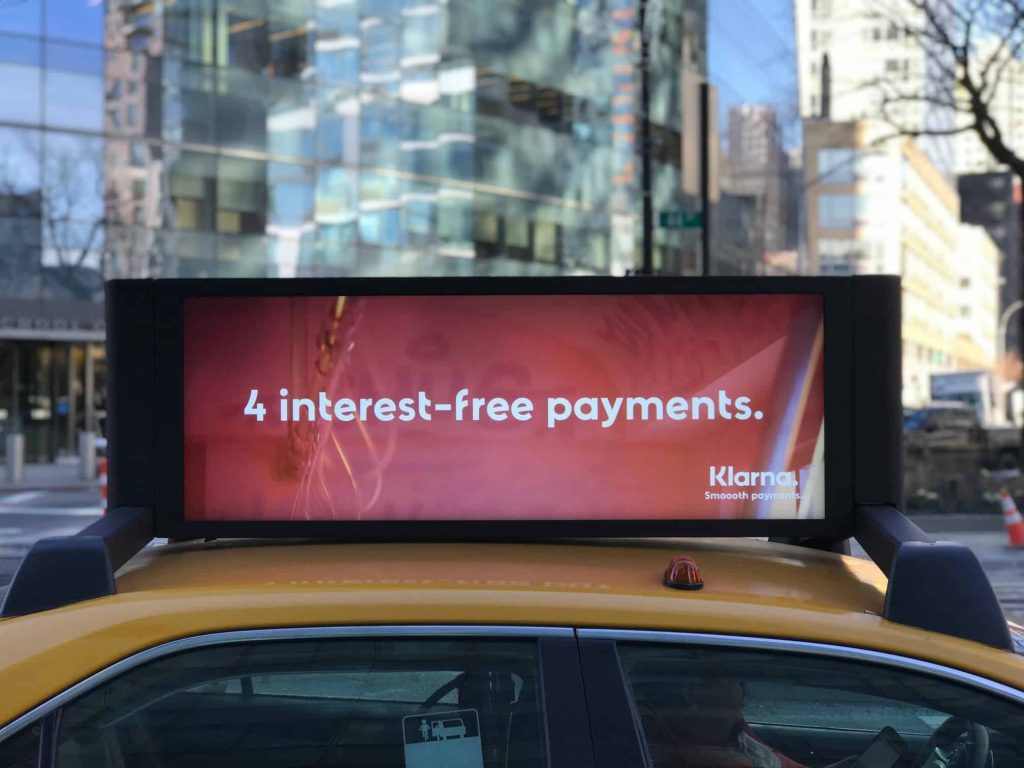
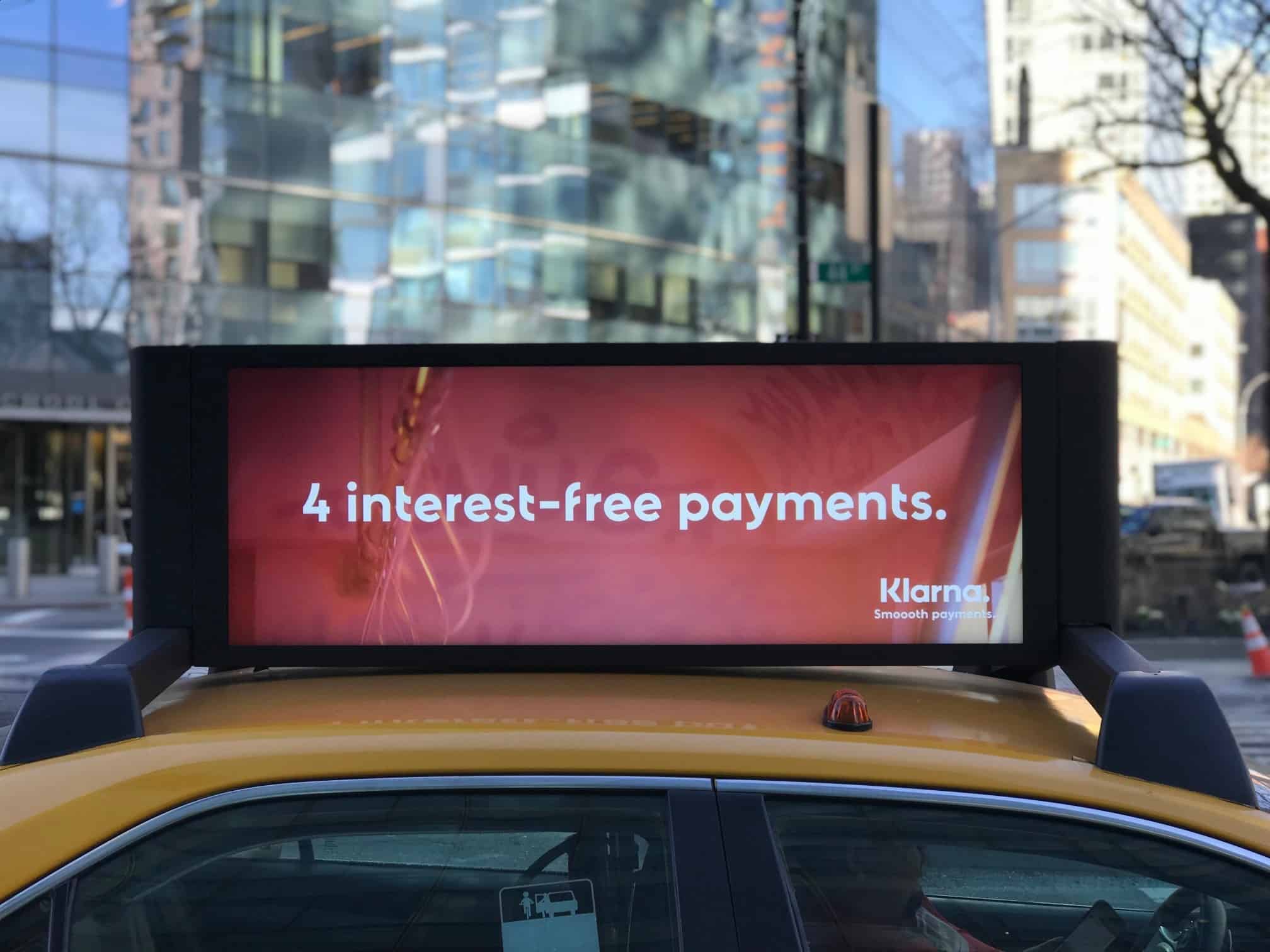
Klarna taxi rooftop display — New York City
Types of taxi advertising
Types of taxi advertising
Rooftop displays
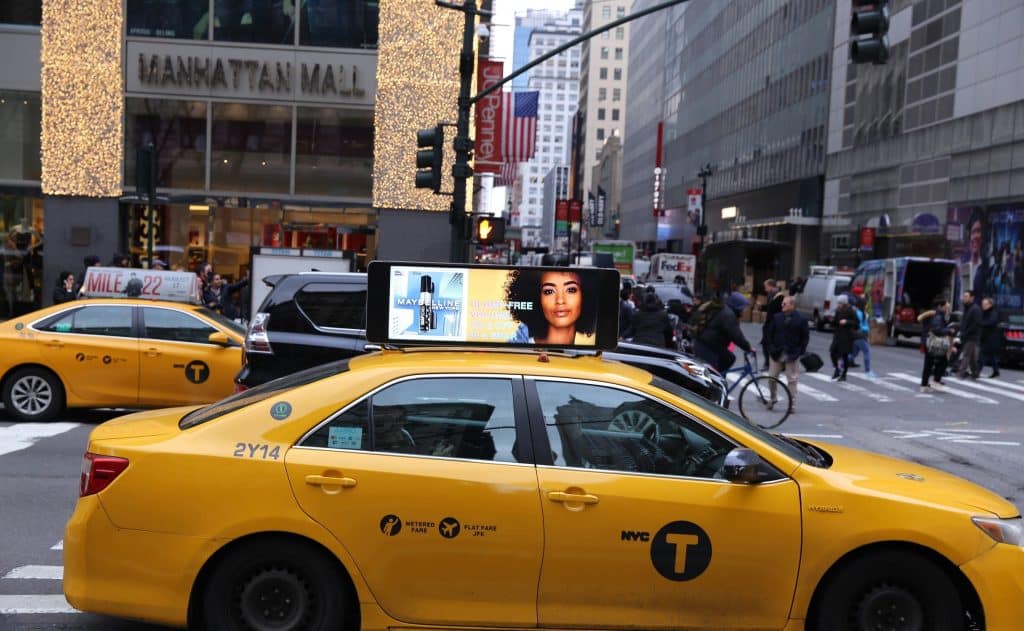
Taxi top advertising is the most recognizable format — a backlit display mounted on the roof, visible day and night. Available in static and digital formats. Digital rooftop units rotate multiple ads and can be updated without reprinting. Cost runs approximately $150–$300 per cab depending on format and market.
Trunk ads
Trunk ads cover the rear of the taxi between the taillights — highly visible to drivers sitting behind the cab in traffic. Static format, full-bleed print. One of the most cost-effective formats at approximately $150 per cab.
Full wraps
Full taxi wraps cover the entire exterior with brand imagery, allowing for complete visual takeover. Bold, high-impact, and impossible to miss. The most premium exterior format due to production costs — pricing varies based on fleet size and market.
Interior screen advertising
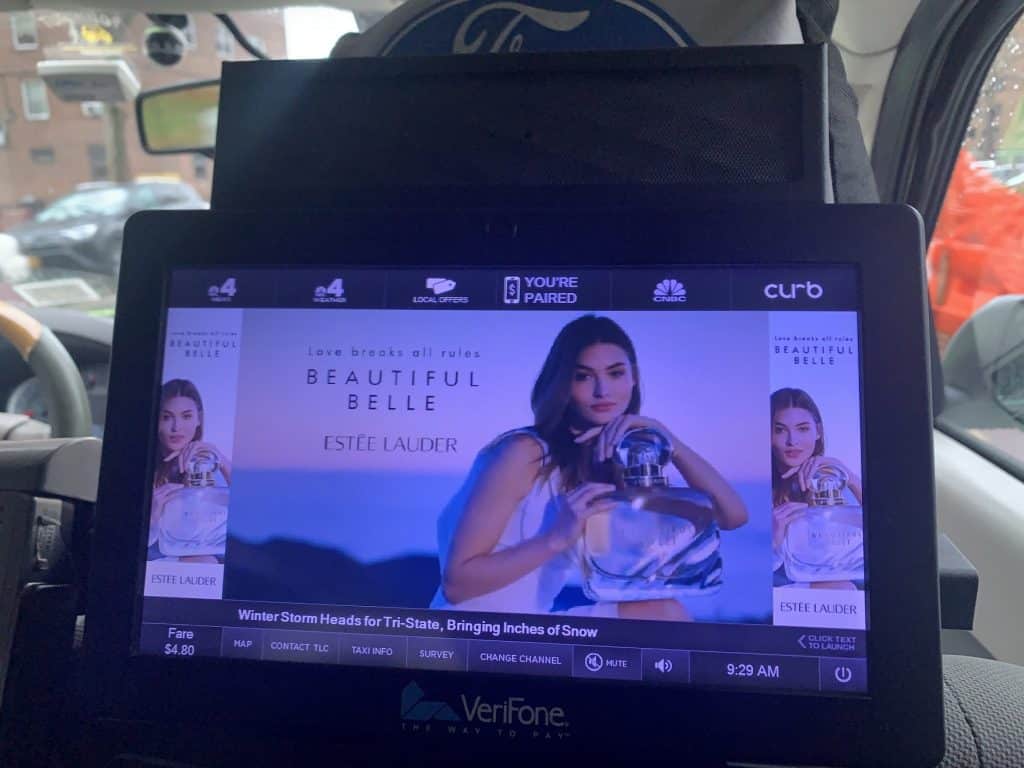
Interior screens are mounted on the back of front seats, showing rotating ads to passengers throughout their ride. Often paired with infotainment content, games, and QR codes linking to promotions. The most affordable format, generally priced per screen with a minimum buy of 1,000 screens.
Pricing
How much does taxi advertising cost?
Taxi advertising costs range from around $30 per cab for interior screen placements to $2,000 per cab for premium full wraps. Most campaigns are purchased in four-week increments, and per-cab rates decrease with larger fleet buys.
| Format | Visibility | Best for | Approx. cost |
|---|---|---|---|
| Rooftop display (static) | Pedestrians, drivers | Brand awareness, simple creative | $150 – $300/cab |
| Rooftop display (digital) | Pedestrians, drivers | Promotions, event marketing | $200 – $400/cab |
| Trunk ads | Drivers behind cab | Traffic-heavy corridors | ~$150/cab |
| Full wrap | All angles | City domination, product launches | $500 – $2,000+/cab |
| Interior screens | Passengers only | Captive audience, video, QR codes | From $30/screen (min. 1,000) |
Contact DASH TWO for current market rates and fleet availability in your target city.
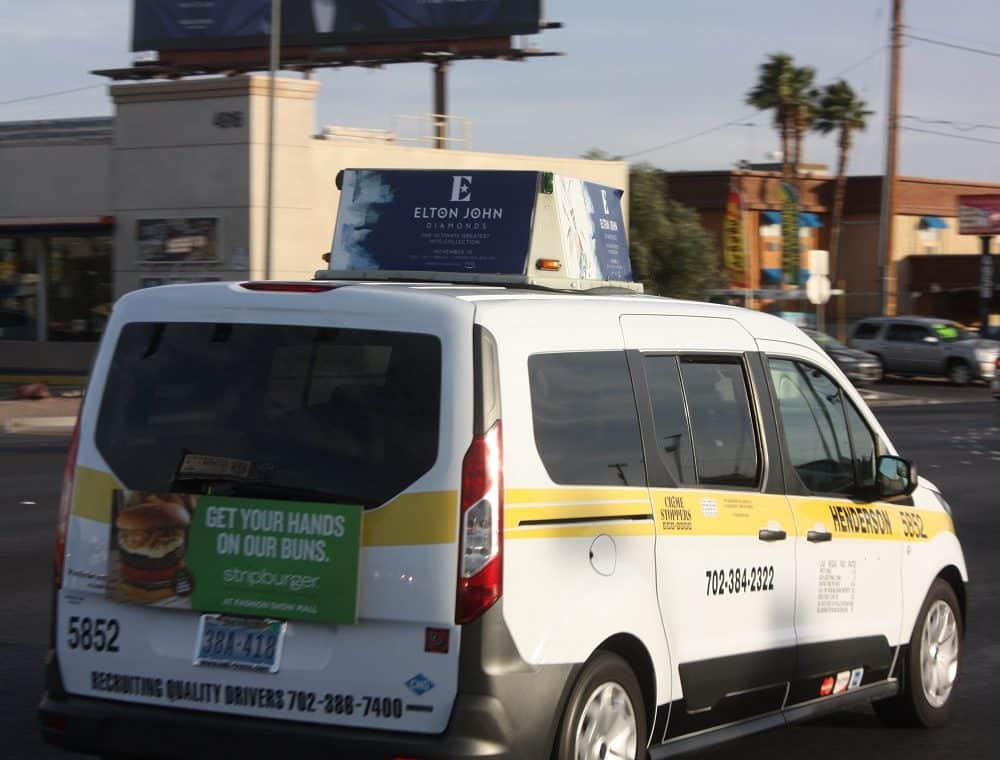
Elton John Diamonds Taxi Rrooftop display
Elton John Diamonds Taxi Rrooftop display
Specifications
Taxi advertising creative specs
Each taxi advertising format has its own production requirements. Submitting files to spec avoids delays and ensures your creative renders correctly on the vehicle. DASH TWO reviews all materials against vendor requirements before a campaign goes live — contact us if you need spec confirmation for a specific market or vendor.
Rooftop display — static
| Spec | Requirement |
|---|---|
| Dimensions | 14" H x 48" W (standard) — confirm with vendor per market |
| Resolution | 300 DPI minimum |
| File format | PDF, AI, or EPS — print-ready, outlined fonts |
| Bleed | 0.25" on all sides |
| Color mode | CMYK |
| Turnaround | 5–7 business days for production and installation |
Rooftop display — digital
| Spec | Requirement |
|---|---|
| File format | MP4 (preferred), HTML5, or static JPEG/PNG |
| Spot length | 6, 15, or 30 seconds — confirm loop length with vendor |
| Resolution | Vendor-specific — typically 1280 x 320px or 1920 x 480px |
| File size | Under 50MB per asset |
| Audio | Muted — no audio on exterior units |
| Turnaround | 48–72 hours once creative is approved |
Trunk ads
| Spec | Requirement |
|---|---|
| Dimensions | Varies by cab model — vendor supplies template |
| Resolution | 300 DPI minimum |
| File format | PDF or AI — print-ready, outlined fonts |
| Color mode | CMYK |
| Turnaround | 5–7 business days |
Full wraps
| Spec | Requirement |
|---|---|
| Template | Provided by vendor per vehicle model |
| Resolution | 100 DPI at full scale (equivalent to 300 DPI at 1/3 scale) |
| File format | PDF or AI — layered, outlined fonts |
| Color mode | CMYK — request a proof, vinyl printing shifts color |
| Turnaround | 10–14 business days for production and installation |
| Removal | Factor in removal cost at campaign end |
Interior screens
| Spec | Requirement |
|---|---|
| File format | MP4 for video, JPEG or PNG for static |
| Spot length | 15, 30, or 60 seconds |
| Resolution | 1280 x 800px (confirm with vendor) |
| Audio | Supported — keep levels moderate |
| Interactive | QR codes and vanity URLs supported |
| Minimum buy | 1,000 screens |
| Turnaround | 48–72 hours for digital delivery |
Contact DASH TWO for current market rates and fleet availability in your target city.
Rideshare
What about rideshare advertising?
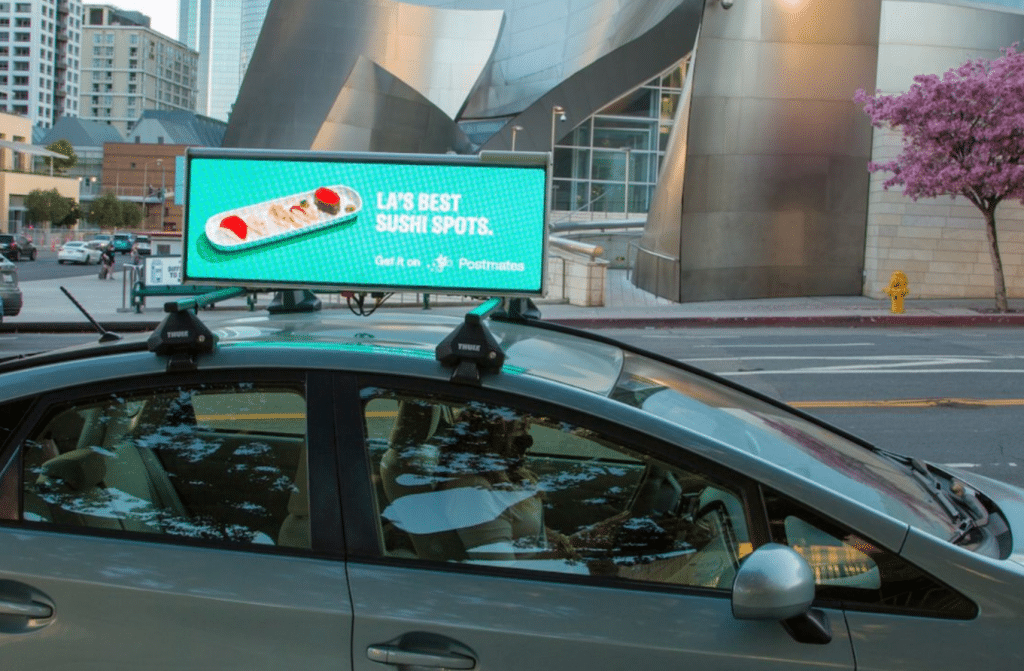
Rideshare advertising extends the same moving-billboard concept to Uber and Lyft vehicles. Formats include rooftop display units and interior screen placements, operating on similar pricing models to traditional taxi advertising. In markets where taxi volume has declined, rideshare advertising can provide comparable or greater reach.
DASH TWO books rideshare advertising campaigns alongside taxi buys, allowing brands to maximize fleet coverage across both networks in a single market.
Who It's For
Who should use taxi advertising?
Taxi advertising works across a wide range of industries and campaign types. The common thread is a need for high-visibility urban reach — brands that want their message moving through a city rather than fixed to one spot.
Entertainment and music
Taxi advertising has a long history in entertainment marketing. Album releases, film premieres, concert tours, and streaming launches all benefit from the format’s ability to blanket a city in the days and weeks leading up to an event. A fleet of wrapped or rooftop-branded cabs in New York or Los Angeles creates the kind of cultural saturation that digital campaigns can’t replicate. DASH TWO has run taxi campaigns for major labels, studios, and artists including Lady Antebellum and Keith Urban.
Retail and e-commerce
Brands looking to drive awareness in specific markets — a new store opening, a seasonal promotion, or a competitive conquest campaign — use taxi advertising to reach shoppers where they’re already moving. Interior screen placements are especially effective for retail, delivering video or QR-coded offers directly to passengers with time to engage.
Financial services and fintech
High-value, broad-reach formats like taxi rooftop displays work well for financial brands building awareness in dense urban markets. Klarna’s NYC taxi rooftop campaign is a strong example — simple, bold creative on a premium format in a market with massive daily foot traffic.
Hospitality and tourism
Hotels, airlines, attractions, and tourism boards use taxi advertising to reach travelers at the moment they’re most receptive — arriving at or departing from a city. Airport corridor routes and hotel district deployments put your brand in front of visitors before they’ve made decisions about where to eat, stay, or spend.
Local businesses
You don’t need a national budget to run a taxi campaign. A local restaurant, law firm, medical practice, or retailer can buy a small fleet in a target neighborhood and dominate their immediate market. Taxi advertising is one of the few OOH formats where a local business can compete on the same streets as a national brand.
Event-based campaigns
Taxi advertising is ideal for campaigns tied to a specific date — a product launch, grand opening, festival, sporting event, or concert. Digital rooftop formats can go live within 48–72 hours and run for as little as a week, making them one of the most flexible OOH options for time-sensitive activations.
Benefits
Why taxi advertising works
Citywide reach
Unlike a static billboard fixed to one location, taxi ads travel through every neighborhood your audience passes through — from downtown corridors to residential streets to event venues.
24/7 visibility
Rooftop displays are backlit and visible after dark, meaning your campaign accumulates impressions morning, afternoon, and night without any additional cost.
Captive audience
Interior screen passengers have average ride times of 10–30 minutes with no competing media. Engagement rates for interior formats consistently outperform other OOH placements.
Cost efficiency
Taxi advertising delivers strong CPMs relative to fixed outdoor formats in the same markets — particularly in New York and Las Vegas where taxi density is highest.
Fast turnaround
Digital rooftop campaigns can go live in as little as 48–72 hours once creative is approved, making taxi advertising one of the fastest OOH formats to activate.
DASH TWO
FAQ
Taxi advertising FAQs
What is taxi advertising?
Taxi advertising is any promotional placement on a taxicab — on the roof, trunk, exterior, or interior screens. Ads run on individual cabs or across entire fleets, giving brands a moving presence throughout a city. Most placements target people who see the taxi from outside, though interior screen advertising reaches passengers directly.
How much does taxi advertising cost?
Taxi advertising costs range from around $30 per screen for interior placements to $2,000 per cab for full wraps. Rooftop displays and trunk ads typically run $150–$300 per cab. Rates decrease with larger fleet buys, and most campaigns are purchased in four-week increments. Contact DASH TWO for current market rates.
What are the benefits of taxi advertising?
Taxi ads function as moving billboards, accumulating impressions throughout a city rather than staying fixed in one location. They reach pedestrians, drivers, and passengers across neighborhoods, business districts, and event venues — around the clock. Fleet buys create a saturation effect that reinforces brand recall across a market.
Where is taxi advertising most effective?
Taxi advertising performs best in dense urban markets with high ridership. New York City and Las Vegas lead in volume, but strong opportunities exist in Chicago, Los Angeles, Miami, and San Francisco. The format works especially well near airports, hotels, entertainment districts, and anywhere tourists and commuters concentrate.
Can I advertise on rideshare vehicles like Uber or Lyft?
Yes. Rideshare advertising extends the same formats — rooftop displays and interior screens — to Uber and Lyft vehicles. DASH TWO books rideshare campaigns alongside taxi buys, allowing brands to maximize fleet coverage across both networks in a single market.
How long do taxi ad campaigns typically run?
Most taxi advertising campaigns are purchased in four-week increments. Shorter runs are available for time-sensitive promotions tied to specific events or dates. Longer commitments often unlock better per-cab pricing and stronger market saturation.
Are there restrictions on what can be advertised on taxis?
Yes. Tobacco advertising is prohibited. Cannabis advertising is restricted or prohibited in most markets depending on state and local regulations. Vendors may also impose their own content guidelines around political, adult, or controversial categories. DASH TWO reviews all creative against vendor requirements before a campaign goes live.
What creative works best on taxi ads?
Keep it simple and bold. Rooftop and trunk ads are seen at a distance and in motion — use high-contrast colors, minimal copy (six words or fewer), and a logo that reads instantly. Interior screen ads can carry more detail since passengers have time to engage. Always design to the specific format specs rather than repurposing creative from other channels.
How quickly can a taxi campaign launch?
Digital rooftop campaigns can go live in as little as 48–72 hours once creative is approved. Static vinyl formats require production time — typically 5–7 business days. Full wraps require the most lead time due to production and installation complexity. Contact DASH TWO early for time-sensitive campaigns tied to events or launch dates.
How is a taxi advertising campaign measured?
Taxi campaigns are measured by impressions (based on DEC — Daily Effective Circulation — for each vehicle’s route), reach, and frequency. Digital formats also support attribution tracking via QR codes, vanity URLs, and promo codes. DASH TWO provides posting confirmation and campaign reporting for all buys.
How It Works
How to buy taxi advertising with DASH TWO
Buying taxi advertising through DASH TWO is straightforward. We handle vendor relationships, inventory sourcing, creative review, and campaign reporting — so you’re not navigating unfamiliar vendor contracts or chasing posting confirmations on your own.
1. Tell us your market and goals
Start with a brief — your target city, campaign dates, budget range, and what you’re trying to achieve. Whether you’re launching a product, promoting an event, or building brand awareness in a new market, we’ll recommend the right format and fleet size for your objectives.
2. We identify inventory and recommend formats
DASH TWO has established relationships with taxi vendors across New York, Los Angeles, Las Vegas, Chicago, Miami, San Francisco, and markets nationwide. We pull available inventory, compare formats side by side, and present options with pricing — so you can make an informed decision without cold-calling vendors yourself.
3. Creative is submitted and approved
Once you’ve approved a plan, your creative goes through vendor review against technical specs and content guidelines. DASH TWO manages this process and flags any issues before they cause delays. If you need creative developed, we can connect you with production resources.
4. Campaign launches
Digital rooftop campaigns go live in as little as 48–72 hours once creative is approved. Static vinyl formats — trunk ads, static rooftop displays, and full wraps — require 5–14 business days depending on format and market. We confirm launch with posting documentation.
5. You receive reporting
At the end of your campaign DASH TWO provides impression reporting based on DEC data for each vehicle’s route, along with posting confirmation for all placements. Digital formats can also be tracked with QR codes, vanity URLs, or promo codes tied to your campaign.
Wild Posting® — Los Angeles
Wild Posting® — MLB
Get In Touch
(310) 439-2356 · 214 S. Locust St. #200, Inglewood CA 90301

Digital and Outdoor Advertising Agency. Expertise in the science of digital and the art of the outdoor.
214 S. Locust St. #200
Inglewood, CA 90301
Services
Resources
Copyright 2026 © DASH TWO, INC. All rights reserved.