
Outdoor Advertising

Wild Posting® in Seattle and the Puget Sound

Pricing, Best Neighborhoods, and How We Run Campaigns in Seattle

We work with companies like…

Adidas Logo
A plain white background with no visible objects or textures.
Puma Logo
Ilia Beauty logo
K18 logo

Cost of a Wild Posting® Campaign in Seattle

Seattle is one of the most culturally weighted Wild Posting® markets in the U.S. — a posting in Capitol Hill or Ballard reads as a credibility signal to music, streetwear, beverage, and tech audiences in a way few other markets can match outside of NYC and LA. What you pay depends on three things: which neighborhood, how many surfaces, and how long the campaign runs. Walkable cores like Capitol Hill, Ballard, Fremont, and the U District command a premium over Downtown or SoDo stretches — and event-cycle windows (Bumbershoot, Capitol Hill Block Party, UW move-in, Seahawks home stands, PAX) can pull rates 15–30% higher than baseline.

Here’s the honest range we see on real campaigns:

Value neighborhoods (SoDo, Georgetown, Bellevue Downtown) $4,000 to $5,500

Best for first-time Seattle advertisers testing the market. Typically a single high-density corridor — Capitol Hill’s Pike/Pine, Ballard Ave, or the U District’s University Way — across 25–40 surfaces for a two-week run. Strong fit for indie music releases, streetwear drops, beverage launches, or single-product B2B SaaS recruitment campaigns.

Mid neighborhoods (University District, Pioneer Square, Belltown) $5,500 to $7,000

Multi-neighborhood coverage across Seattle proper — typically Capitol Hill + Ballard + Fremont + one other, 60–120 surfaces, three to four weeks. The mid tier is where most national tech and CPG launches land: enough surface count to register in repeat exposure, enough neighborhood spread to reach distinct audience segments without diluting the campaign.

Premium neighborhoods (Capitol Hill, Ballard, Fremont) $7,000 to $8,000

Citywide saturation including Capitol Hill, Ballard, Fremont, U District, Pioneer Square, Belltown, SoDo / Stadium District, and (optionally) Bellevue Downtown. 200+ surfaces, four to eight weeks. Standard for product launches with major Seattle activation tie-ins (PAX, Bumbershoot, Seahawks season opener, Amazon re:Invent overflow), national brand-awareness pushes, and any campaign where the Capitol Hill / Ballard cultural-credential framing is a primary creative goal.

Cheapest Areas to Run Wild Posting® in Seattle

Most Expensive Areas to Run Wild Posting® in Seattle

A typical first campaign for a brand new to Seattle lands between $4,000 and $6,000 — enough density to make an impact across one or two neighborhoods without overcommitting before you’ve seen results.

Bird scooter "Fly for Free" Wild Posting® campaign in Downtown Seattle near Pioneer Square
Bird's "Fly for Free" first-ride acquisition campaign — dual-measurement creative pairing QR scans with the SPRINGCHICK promo code — running on the Marion and Post corner in Downtown Seattle, across from the historic Colman Building.

Where to Run Wild Posting® in Seattle

The mechanics are the same in every market — but the local execution is where campaigns succeed or fail. Here’s how we run Detroit specifically.
Childish Gambino "Camp" album Wild Posting® campaign on Broadway in Capitol Hill, Seattle
Childish Gambino's "Camp" album release — a multi-poster saturation grid on Broadway E in Capitol Hill, the strongest cultural-credentials Wild Posting® corridor on the West Coast outside of LA's Melrose stretch. The campaign reached the music, creative, and Gen Z / millennial audience that defines the neighborhood.

Capitol Hill (Pike/Pine corridor)

Seattle’s densest, most walkable, most poster-friendly neighborhood — and the strongest single corridor on the West Coast outside of LA’s Melrose stretch. Pike Street and Pine Street between Broadway and 12th anchor the bar, music venue, coffee, and indie retail economy. Reaches young creatives, the LGBTQ+ community, music and nightlife audiences, and the Gen Z / millennial professional class living in the surrounding apartment density. This is where music labels, streetwear brands, beverage launches, and indie film campaigns post first.

Ballard (Ballard Avenue + Market Street)

Historic maritime neighborhood turned dense walkable corridor. Ballard Avenue between 17th and 22nd is the bar / brewery / boutique / restaurant spine; Market Street carries the higher-volume traffic and chain retail. Reaches a 25–45 professional and creative-class audience with strong craft-beverage, outdoor-brand, and home-goods affinity. The Sunday farmers’ market pulls 10,000+ weekly during peak season.

Fremont (Fremont Avenue + 36th Street)

“The Center of the Universe” — Seattle’s quirkiest walkable core, anchored by the Fremont Sunday Market, the Troll, Adobe’s regional office, Tableau’s old HQ, and a dense bar / restaurant / coffee / indie retail corridor. Reaches a creative-tech crossover audience that overlaps Capitol Hill’s creatives with Downtown’s tech workers. Strong fit for tech recruitment, design-tool campaigns, and any brand whose audience is “smart, quirky, and skeptical of mainstream.”

University District (University Way / "The Ave")

University of Washington’s pedestrian commercial spine — 50,000+ students, walkable from campus, year-round dorm and apartment density. The Ave (University Way NE between NE 41st and NE 50th) is the highest-volume Gen Z corridor in the Pacific Northwest. Reaches undergraduates, graduate students, and the surrounding 18–24 demographic. Best for streaming launches, app installs, music releases, food and beverage targeting students, and any campaign timed to the academic calendar.

Pioneer Square

Seattle’s oldest neighborhood and gallery / architecture / design anchor. Walkable, dense, and increasingly residential after a decade of conversion. Reaches a design-literate, arts-aware audience plus the Downtown lunch and after-work crowd. First Thursday Art Walk pulls reliable monthly foot traffic. Strong fit for design tools, architecture firms, gallery openings, and premium streetwear that wants gallery-adjacent placement.

Belltown

Downtown-adjacent dense residential and nightlife corridor between Denny and Virginia. Reaches a young-professional audience living and partying in the neighborhood — strong fit for spirits, dating apps, fitness, and lifestyle brands. Less culturally weighted than Capitol Hill but higher overall foot traffic.

South Lake Union (SLU)

Amazon’s Seattle campus. Dense, walkable, and almost entirely tech-workforce by daytime population. Limited traditional wild-posting inventory — this is a barricade and construction-wall market rather than a wheatpaste market — but for B2B SaaS, developer-tool launches, recruitment campaigns, and anything targeting Amazon employees specifically, the corridor between Westlake and Fairview, Denny and Mercer is the best targeted reach in the city.

SoDo / Stadium District

Lumen Field (Seahawks, Sounders) and T-Mobile Park (Mariners) sit adjacent. Industrial / light-manufacturing corridor with strong event-cycle foot traffic on game days and concert nights. Worth pricing into any campaign timed to NFL season, MLB summer home stands, or stadium concert windows.

How DASH TWO Runs Wild Posting® Campaigns in Seattle

The mechanics are the same in every market — but the local execution is where campaigns succeed or fail. Here’s how we run Detroit specifically.
Here’s what running an LA campaign with us looks like:

1. Strategy and neighborhood selection.

We start with the campaign’s audience and the brand’s media calendar, then map them against Seattle’s foot-traffic and event windows. A campaign launching against Capitol Hill Block Party (July), Bumbershoot (Labor Day weekend), UW move-in (late September), PAX (late August / early September), a Seahawks home stretch (September through January), or the holiday retail window needs different surface counts and a different posting cadence than a non-event-tied launch.

2. Surface sourcing.

Seattle’s Wild Posting® inventory mixes construction barricades, scaffolding wraps, property-owner-agreement walls, and tolerated postering corridors. The Amazon / South Lake Union build-out and the ongoing Capitol Hill, Ballard, and Bellevue residential boom have put more construction barricade inventory in play than any other Pacific Northwest city over the past decade — we map availability against the campaign window and lock surfaces directly with owners and contractors.

3. Permits and compliance.

Seattle’s sign code is enforced through the Seattle Department of Construction and Inspections (SDCI). Where permits are required, we handle them. Where private-property agreements govern the surface, we secure them in writing. Bellevue, Redmond, and Kirkland have separate municipal authorities on the Eastside — same standard applies. We don’t run inventory we can’t document.

4. Production.

Posters printed locally where possible (we work with Seattle-area printers for shorter freight cycles), spec’d for the substrate and the weather window. The Seattle wet season is real — wheatpasting and surface adhesion change between October and April, and we adjust paper weight, paste mix, and install schedule accordingly. Moisture-rated adhesives, ink sets, and substrates are standard across the wet-season window.

5. Install and verification.

Local install crew, geo-tagged photo proof of every surface, delivered as a verification report. Reposting where needed — Seattle’s sustained-moisture cycle is harder on posters than dry-climate markets, and we build re-post passes into the schedule for any campaign running more than three weeks October through April.

6. Impressions modeling and reporting.

Foot-traffic counts modeled against the actual surface locations, with Capitol Hill (Pike/Pine), Ballard Avenue, Fremont, and the University District corridors as the high-density anchors. Event-window uplift modeled separately where applicable (Bumbershoot, Capitol Hill Block Party, UW football Saturdays, Seahawks home games, Sounders home matches, Mariners summer stands).
Pixies and Kate Moss for Topshop Wild Posting® campaigns on Pike Street in Capitol Hill, Seattle

Examples of Wild Posting® Campaigns We've Run in Seattle

Bird "Fly for Free" — Downtown Seattle / Pioneer Square edge
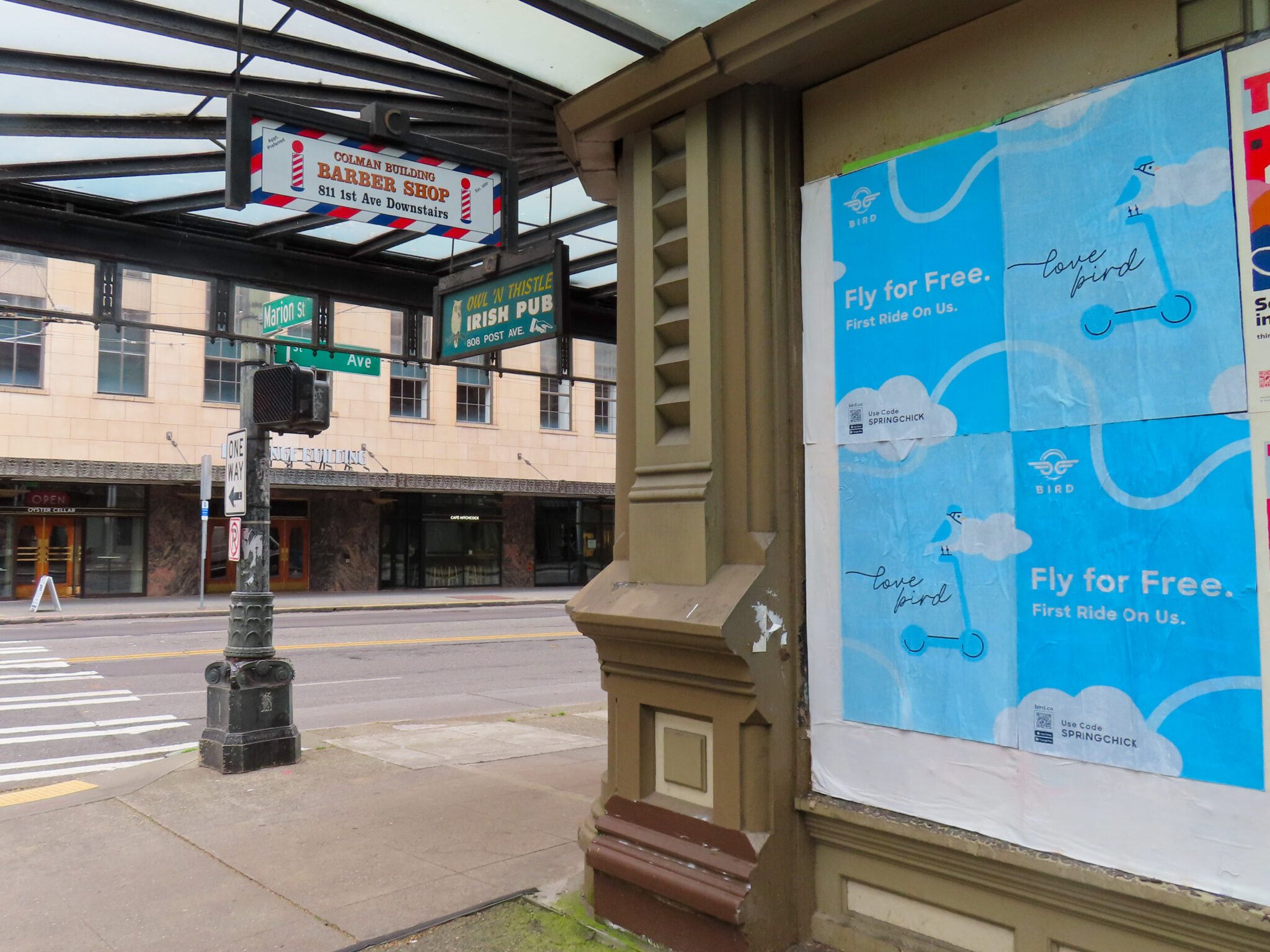
Bird ran a first-ride acquisition campaign across Downtown Seattle’s West Edge corridor, anchoring on the Marion + Post corner across from the historic Colman Building. The creative paired a QR code routing to bird.co with a SPRINGCHICK promo code for attributed first rides — dual measurement that tied wild posting directly to app installs and ride starts. The neighborhood mix was chosen for commuter throughput: this stretch of Downtown sits on the daily walk between Pike Place Market and Pioneer Square, with apartment density above and tourist foot traffic below. For brands using wild posting as a performance channel rather than a brand-awareness channel, Bird’s campaign is the proof: QR scans and promo redemptions both reported back into the same dashboard as paid digital, at a CPA the media plan could compare line-for-line.
Bird scooter "Fly for Free" Wild Posting® campaign in Downtown Seattle near Pioneer Square

Childish Gambino "Camp" album release — Broadway E, Capitol Hill

Childish Gambino’s “Camp” album release ran a saturation grid on Broadway E in Capitol Hill — the West Coast’s strongest cultural-credentials Wild Posting® corridor outside LA’s Melrose. Repeating posters on a single corner read as “the artist took over this neighborhood,” which is the cultural-permission play labels post Capitol Hill to make. DASH TWO has been the wild-posting partner for major label music campaigns here for over a decade.
Childish Gambino "Camp" album Wild Posting® campaign on Broadway in Capitol Hill, Seattle

Pixies + Kate Moss for Topshop — Pike Street, Capitol Hill

Two campaigns sharing one Capitol Hill wall on Pike Street: a Pixies Indie Cindy saturation grid and a Kate Moss for Topshop / Nordstrom luxury fashion launch, running concurrently. The cohabitation is the case study. Indie rock and Nordstrom-tier fashion choose the same corridor for the same reason — Capitol Hill is the West Coast’s strongest cultural-credentials wild-posting environment, and brands across categories post here to access it.
Pixies and Kate Moss for Topshop Wild Posting® campaigns on Pike Street in Capitol Hill, Seattle

Frequently Asked Questions About Wild Posting® in Seattle

Everything brands ask us before booking a Wild Posting® campaign in Seattle.

How much does Wild Posting® cost in Seattle?
Seattle Wild Posting® campaigns range from $4,000 (entry tier, single corridor, two-week run) to $8,000 (premium tier, citywide saturation, four to eight weeks). What you pay depends on neighborhood mix, surface count, and campaign duration. Capitol Hill, Ballard, and Fremont command a premium over Downtown, SoDo, and outer corridors.
Capitol Hill (Pike/Pine corridor) is the strongest single Wild Posting® neighborhood on the West Coast outside LA’s Melrose stretch — high pedestrian density, nightlife economy, cultural permission, and a Gen Z / millennial creative audience. Ballard, Fremont, and the University District round out the top tier. Pioneer Square, Belltown, and SoDo serve specific audience niches.
Yes. Every surface DASH TWO posts in Seattle is on a wall covered by a current property-owner agreement, with permits handled in-house. No guerrilla posting, no liability exposure for the brand.
All DASH TWO Seattle campaigns running October through April use moisture-rated adhesives, ink sets, and paper substrates. Campaigns ship at the spec they were quoted at — no re-postings or weather-degradation issues.
Yes. Seattle pairs particularly well with Portland for a Pacific Northwest creative-class buy, with San Francisco for a West Coast tech-workforce buy, and with LA or NYC for national rollouts. We coordinate creative, posting schedule, and verification reporting across markets from a single brief.
Yes. DASH TWO covers Bellevue Downtown and the Spring District corridor as part of Seattle Wild Posting® campaigns, with Redmond and Kirkland available as extensions. The Eastside reaches a high-income tech-workforce audience that Seattle proper doesn’t — best paired with SLU for citywide tech recruitment campaigns.

Ready to Run Wild Posting® in Seattle?

Contact us with your timing, budget, and target audience. We’ll come back with a neighborhood plan, surface count, and impression model within 48 hours — no obligations, no decks you have to sit through.